Imec (Europractice)
Europe's gateway to microelectronic technologies, rebuilt
Imec's Europractice helps industry and academic researchers turn microelectronic designs into physical prototypes, but the existing portal was ageing, manual-heavy, and no longer scalable. The platform needed a future-proof rebuild that also integrated with third-party systems to cut down manual input. The result is a new UX foundation (concepts, layouts, components, and design tokens) built to carry a more secure, user-friendly design-to-manufacturing flow, and solid enough for the rest of the design team to keep building on.
- Role
- Product Designer
- Timeline
- 2023 – 2024
- Skills
- Product DesignSystem Thinking
What Europractice actually does
Europractice is a brokerage service that gives industry and academia affordable, easier access to microelectronic and smart systems technologies. Imec sits in the middle, mediating between customers and technology providers, stimulating collaboration and innovation across application domains.
The platform is the first step toward building a physical prototype: customers register a design, it gets validated internally by the chosen service partner, and it's manufactured over a fixed timeline called a run. A contact person stays assigned to that registration for any follow-up.
Why rebuild it
The existing Europractice portal needed a future-proof, stable replacement: user-friendly, secure, and scalable. Just as important, the new platform had to cut down manual input by integrating with several third-party systems, so the business process itself ran more efficiently, not just the interface on top of it.
Laying the foundation for others to build on
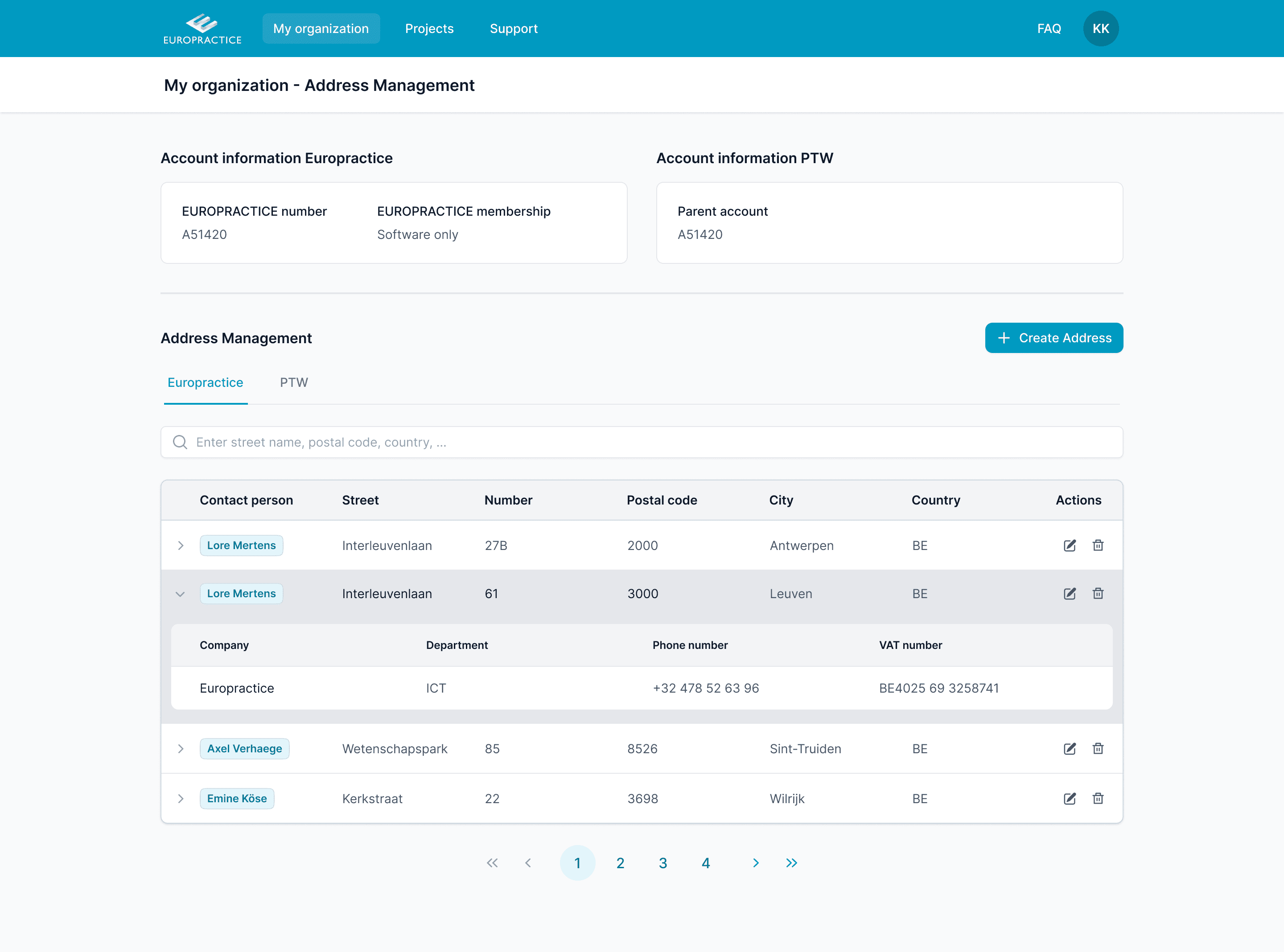
My role was to set the groundwork the rest of the design team would build on: UX concepts, page layouts, components, and design tokens, alongside the key screens that gave shape to the platform's core flows. This wasn't about designing every screen myself. It was about establishing a foundation solid enough that fellow UX colleagues could pick it up and keep building without having to reinvent decisions along the way.
That work happened while priorities were still being aligned with an external partner and with internal business and ICT teams, and while the MVP scope itself was still taking shape, so the foundation had to hold up under a moving target, not just a finished brief.
The result
A rebuilt Europractice platform with a UX foundation, concepts, layouts, components, and tokens, built to carry the rest of the design work forward: a more user-friendly, secure, and scalable experience for registering and tracking a design through to manufacturing, with reduced manual input through the platform's third-party integrations.